 Robin Forge Ventures
Your members ask. Your own documents answer.
Talos answers a question from your association's declaration, bylaws, rules and minutes. It quotes the sentence and links the section. When the documents don't say, it says so instead of guessing.
The answer is in your documents. Talos finds the sentence.
The same questions arrive every week: where does it say that, can they do that, who may see this. The answer is in a declaration, a bylaw, a rule or the minutes, and someone has to go and find it.
Talos is for HOA boards and community managers. It is private: only people the board invites can read the documents or ask. When the records hold the answer, it gives you the association's own words and a link to the section. When they don't, it gives a plain "not in the records" and the office's contact.
This is a demo with a made-up association, Maple Ridge. The people and the community are made up. It is not legal advice.
Made-up demo. Maple Ridge HOA, Gloria Hart (board) and Marcus Bell (manager) are made up. No real association, person or address is shown.
Offline. In this demo, answers are quotations or a plain decline. No AI model is used and no question goes to an AI provider.
Private. Only invited members can read the documents or ask.
Pricing on request.Ask a real question. Get the sentence, or a plain no.
53 seconds. A made-up board asks about the trash rule, then asks something the records do not hold.
Read the short-demo transcript
Every board and every community manager answers the same questions again and again. Where does it say that? Can they do that? Who is allowed to see this?
Talos is private. Only people the board invites can come in. This is Maple Ridge, a made-up association.
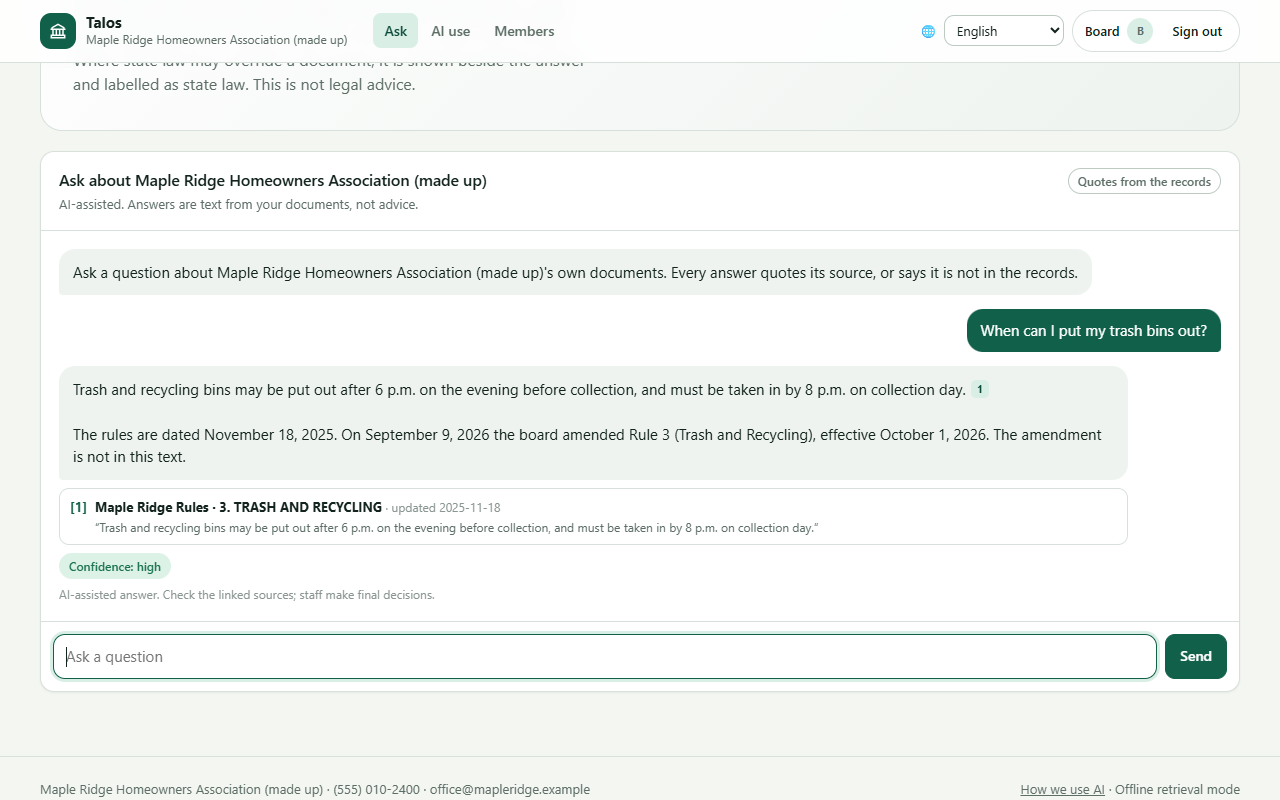
Ask a question. When the documents answer, you get the association's own sentence, with the section it came from, and it tells you which version it quoted.
When the records don't say, Talos says so and points to the office. It doesn't guess.
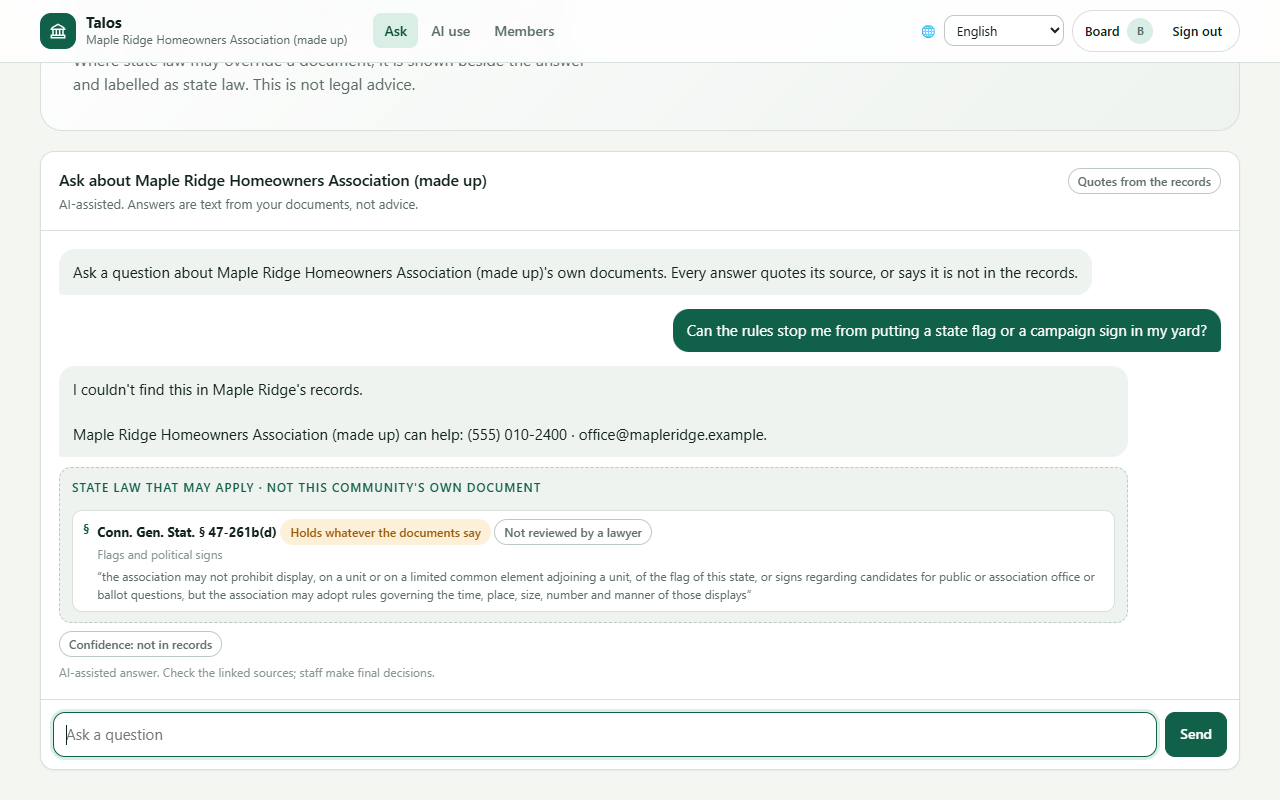
Where Connecticut law may apply, it appears beside the answer, labelled as state law, and marked as not reviewed by a lawyer in this demo.
Talos. Answers from your own documents. Made-up demo. Offline. Gate not passed: 14 of 27 public. Pause and month export are not in this demo. Book a demo at robinforgeventures.com.
A small, honest set of jobs
Every item below is in the demo. The gaps are listed further down, in the same plain language.
Quotes, or declines
An answer is the association's own sentence with a link to its section, or a plain "not in the records" with the office's contact. It does not invent a rule or a date.
Invited members only
The board invites people. Nobody else can read the documents or ask the assistant. The board can see who was invited and who joined, and can remove someone.
State law beside the answer
Where Connecticut law may apply, it is shown beside the answer, labelled as state law, never mixed into the association's words. In the demo it is marked "Not reviewed by a lawyer".
The month's counts
The board sees how many questions were asked, answered from the documents and declined. Counts only: who asked is not shown. In the demo a manager sees them by signing in as the board.
An audit record
The administrator keeps an append-only, hash-chained record of answers. A changed record is detectable. The board cannot see or export it yet.
At phone width
Answers and the Members controls work at 390 px, including the Remove confirm. The demo video shows the phone screens.
What a board can trust, and what to try first
This is the board leave-behind, in the same words we would hand you on a call.
- It quotes your documents, or declines.It does not invent a date or a rule.
- It says which version it quoted.If a rule has been amended after the text it holds, the answer says so.
- It will not tell an owner they may do something.It quotes the rule, or sends the judgement call back to the board. Answers are labelled AI-assisted, and staff make the final decision.
- Only members you invite can read your documents or ask.You decide who is in, and you can remove someone.
- State law is shown beside the answer, never mixed into it.With its citation and the statute's words. In the demo it is marked "Not reviewed by a lawyer".
- The board sees the month's question counts.Asked, answered from your documents, declined. Counts only: who asked is not shown.
- The administrator keeps an append-only audit record.The board cannot see it yet.
Try this before you forward it. Ask your own question first. Ask it in your own words, then in the document's words. See what happens. That is the test we would give another board.
The weekly rule question, answered from the document
An owner phones or emails: renting, guest parking, trash days, who fixes the deck. You find the right document and write back with the section. Talos gives you the sentence, the source and the date of the version it quoted, so you can paste it into your reply.
Ask and paste
Get a quotation with its source, or a plain "not in the records" with the office's contact. It does not guess.
Invite, resend, see who joined
Invite an owner, see the invited and joined dates, and resend a code that was lost.
The month's counts
See how many questions owners asked, how many were answered and how many declined. Counts only, no names.
Remove after a sale
Remove an owner who has sold. It asks first, and their access ends straight away.
Only invited people get in. The board invites people. In the demo a manager signs in as the board, because a manager cannot yet be invited as a manager. Nobody else can read the documents or ask.
Try it first: ask us to run your own question on the demo. Book a demo.
The eight-step demo, about two minutes
Sign in, ask the five path questions, open the source, invite a member, see the phone screens, remove someone, and see the month's counts. This is the cut a seller would play on a call.
Read the full-walkthrough transcript
Every board and every community manager answers the same questions again and again. Where does it say that? Can they do that? Who is allowed to see this?
Talos is private. Only people the board invites can come in. This is Maple Ridge, a made-up association.
Ask a question. When the documents answer, you get the association's own sentence, with the section it came from, and it tells you which version it quoted.
When the records don't say, Talos says so and points to the office. It doesn't guess.
Where Connecticut law may apply, it appears beside the answer, labelled as state law, and marked as not reviewed by a lawyer in this demo.
For a manager, here shown signed in as the board today: invite an owner, and see who has accepted and joined. The manager and board are made-up demo personas.
And when an owner sells, remove them. It asks first, and they lose access straight away.
On a phone, a member signs in with the invitation code and asks the same question; the answer is the same. The board sees who joined, and the Remove confirm is on the same screen. These are the same screens from the same run at 390 pixels.
For a board: ask when the board meets, and it quotes the bylaw. Where the records don't hold an answer, it says so instead of guessing.
The board can also see the month's counts: how many questions were asked, how many were answered from your documents, and how many were declined. Counts only, never who asked.
Talos. Answers from your own documents. It runs offline on this computer with no AI model, so no question leaves it. Not in this demo yet: pausing an out-of-date source and exporting the month. Setup time, hosting, where data would be kept, and support are not decided. We would rather say so than guess. Pricing on request.
Gate not passed: 14 of 27 public (bar 25 of 27). Guest-overnight and political-sign wordings decline. Pause and month export are not in this demo. Made-up demo. Offline. Pricing on request.
The gap is said out loud
The answer gate is not passed.
On the final tag, the public set measured 14 of 27 answerable questions correct, with 18 of 18 correct declines and 0 fabricated, leaks or unsafe. The bar is 25 of 27. The held-back set is reported, not gating. A wrong source counts as wrong.
What it does not do yet
- Everyday wordings sometimes decline. Can guests park overnight? declines today; Where do guests park? answers. Political-sign wordings also decline.
- A manager cannot be invited as a manager; in the demo the manager signs in as the board.
- No Documents page to see each document's date or pause an out-of-date source.
- The board cannot see or export the audit record, or export the month's questions and answers.
- It is not a meeting-prep or agenda tool yet: no next meeting, notice deadline, quorum, last minutes or draft agenda.
- Where a state-law card appears beside a decline, it can read as an answer. We are narrowing when it appears.
What we haven't decided yet
- How long it takes to set up one association, and who loads the documents.
- Whether a hosted version uses an AI model, and where each association's data would be kept. This demo runs locally and offline.
- How a wrong or missing answer is reported and who fixes it.
- Support hours and who you call.
- One sign-in for a manager with many associations.
Maple Ridge, Gloria Hart and Marcus Bell are made up. The demo is not legal advice. Pricing on request.
What a seller would show, in order
- Sign-in. Say it is a made-up association. Only invited people get in.
- Sign in as the board. Point out the role.
- Ask who repairs the deck. Show the quotation and open the section.
- Ask the trash rule. Show the note that a newer amendment is not in the text.
- Ask for another owner's phone number. Show the plain decline and the office's contact.
- Ask about a flag. Show state law beside the answer, marked not reviewed by a lawyer.
- Invite an owner, then remove one. The code is on screen because the demo sends no email; Remove asks first.
- Show the phone screens and the month's counts. Counts only, no names.
- Say the gaps, then hand over the keyboard. Let them ask their own question. Do not coach.
Full cue sheet: the ten-minute call script. Leave-behinds: board and manager.
See it with your own question
Tell us about your association and the question you would ask first. We will run it on the made-up Maple Ridge demo and show you the answer, the section or the decline.
Or email sales@robinforgeventures.com. Pricing on request. This is not legal advice.
What you are seeing is a demo. Maple Ridge, Gloria Hart and Marcus Bell are made up. The software runs locally and offline in this demo; there is no hosted service or AI provider behind it.
What is not decided: setup time, hosting, data location, support hours and one sign-in across associations.
No real association, person or address is shown.